| Programme | |
|---|---|
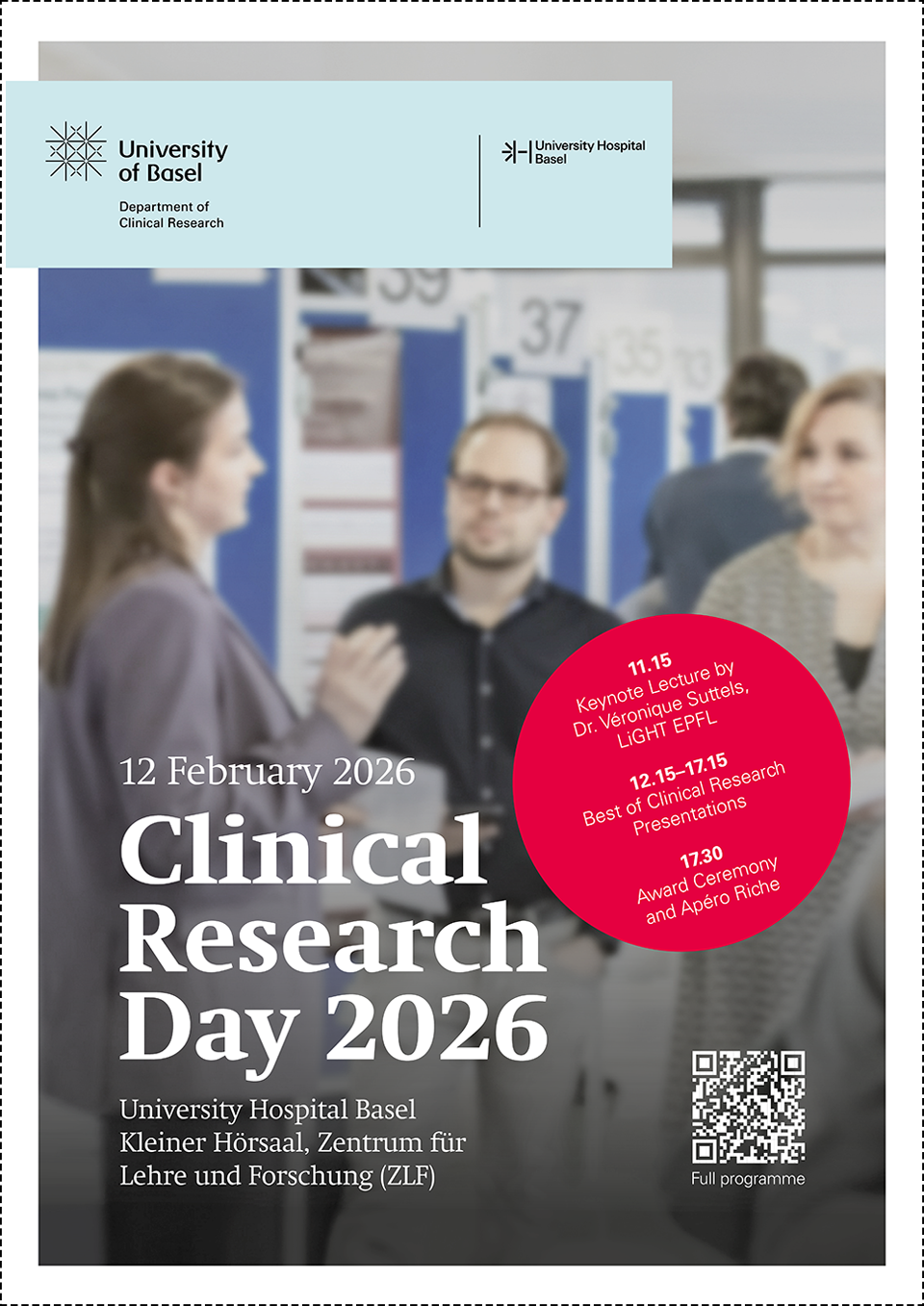
| 11.15 | Opening remarks Niklaus Labhardt and Christiane Pauli-Magnus (Co-Directors, Department of Clinical Research) |
| 11.25-12.10 | Keynote Lecture «Are we thinking faster, fast and slow? Opportunities and Pitfalls of A.I. in Clinical Research» Dr. Véronique Suttels, MD, PhD, Laboratory for Intelligent Global Health & Humanitarian Response Technologies (LiGHT) at the Swiss Federal Institute of Technology in Lausanne |
| 12.10-13.15 | Oral Presentations Training and Validation of a 12-lead ECG-Based Deep-Learning Model for Myocardial Infarction Subtypes Nasal chondrocyte Tissue Engineered Cartilage for the treatment of patellofemoral osteoarthritis – a pilot clinical study Randomized Comparison of ctDNA-Guided Management vs. Usual Care in Advanced Solid Cancer: The LIQPLAT Trial Diagnosing Vasopressin deficiency using Mannitol-stimulated Copeptin |
| 13.15-14.15 | Lunch |
| 13.15-14.15 | Poster Walks A - Shortlisted Posters (1-9) |
| 14.15-14.30 | Hemmi Prize Award Ceremony Molecular tissue-based precision diagnostics for infectious diseases RB1 loss and depth of homologous recombination deficiency as predictors of outcomes with olaparib and bevacizumab in first-line maintenance of ovarian cancer: a PAOLA-1 substudy |
| 14.30-15.15 | Turbo Presentations Bridging the Gap: External Validation of Deep Learning Algorithms Using High-Quality Prospective Cohorts Pool-testing to increase efficiency of antibiotic-resistant bacterial colonisation surveillance in neonatal units: a simulation study Untreated, uncontrolled, and below-target hypertension in southern Africa: a population-based prevalence and care cascade assessment in rural Lesotho The Value of Intravenous Thrombolysis for Patients with Suspected Lacunar Stroke: An International Survey Study Effect of switching to an integrase strand transfer inhibitor (INSTI)-based regimen on cardiovascular disease risk for individuals with controlled HIV – A target trial emulation using Swiss HIV Cohort Study data Diagnostic accuracy of an AI-based ECG algorithm for atrial flutter: a prospective comparison with electrophysiological study Influence of Prior Knee Surgery on Early Revision Risk for Infection After Primary Total Knee Arthroplasty: A SIRIS Registry Analysis Risk factors associated with type 2 perioperative myocardial infarction in patients with bleeding after non cardiac surgery Public voting for best Turbo Presentation |
| 15.15-15.45 | Break |
| 15.45- 17.00 | Oral Presentations Community-based hypertension care in rural Lesotho – a cluster-randomized trial within the ComBaCaL cohort study Robotic process automation to identify patients at high risk for perioperative myocardial infarction or injury: a prospective, blinded, paired reader-controlled single-centre study Cancer risk management and surveillance in HBOC and Lynch syndrome: Findings from the Swiss, Korean, and Israeli CASCADE cohorts Transmission of extended-spectrum β-lactamase–producing Enterobacterales other than Escherichia coli in hospitalized patients [⁶¹Cu]Cu-NODAGA-LM3 versus [⁶⁸Ga]Ga-DOTATOC in the same patients with neuroendocrine tumours: Preliminary results of the Phase I/II COPPER-PET-in-NET Trial |
| 17.30-21.00 | Apéro Riche and Award Ceremony |
Please note: Attending the Clinical Research Day is free-of-charge and does not require registration.
Dear colleagues
Artificial intelligence (AI) and large language models (LLMs) are increasingly shaping both our private and professional lives. But how will these technologies influence the way we conduct clinical research? What opportunities will they create, and what challenges will we face?
We are delighted to announce that this year’s keynote lecture, “Are we thinking faster, fast and slow? Opportunities and pitfalls of A.I. in clinical research”, will be delivered by Véronique Suttels, senior clinician scientist at EPFL’s Laboratory for Intelligent Global Health & Humanitarian Response Technologies (LiGHT).
Dr. Suttels is specialised in internal medicine and infectious diseases and completed her PhD on AI assisted lung ultrasound for tuberculosis detection at LiGHT EPFL and CHUV. Her keynote will offer an expert, practice-oriented perspective on how AI is transforming clinical research today—and what this means for future innovation.
The subsequent scientific programme will showcase the department’s diverse research activities, with a particular focus on contributions from early-career researchers. Presentations will take place in both oral and poster formats, highlighting the variety of ongoing projects. A scientific jury will select the three best oral presentations and the three best posters, while the best turbo-presentation will be chosen through audience voting. For the first time, we will also award a special prize for the most creative poster and the most creative oral presentation.
At the end, we will meet for an apéro riche, the award ceremony and the opportunity for informal exchange and networking.
We are looking forward to a varied overview of current clinical research projects and an exciting and inspiring research day.
Christiane Pauli-Magnus and Niklaus Labhardt (Co-Directors DKF)
Benjamin Speich, Katja Suter (Senior Researchers DKF)
Steve McCrosky
Scientific Coordinator
Phone +41 61 328 77 17